SaaS outages expose enterprise dependency on third-party platforms
GitHub, Google Cloud, Google Drive, ChatGPT, Claude, Grok and Salesforce all faltered in a month, showing how one internal service or shared dependency can stall work across companies.
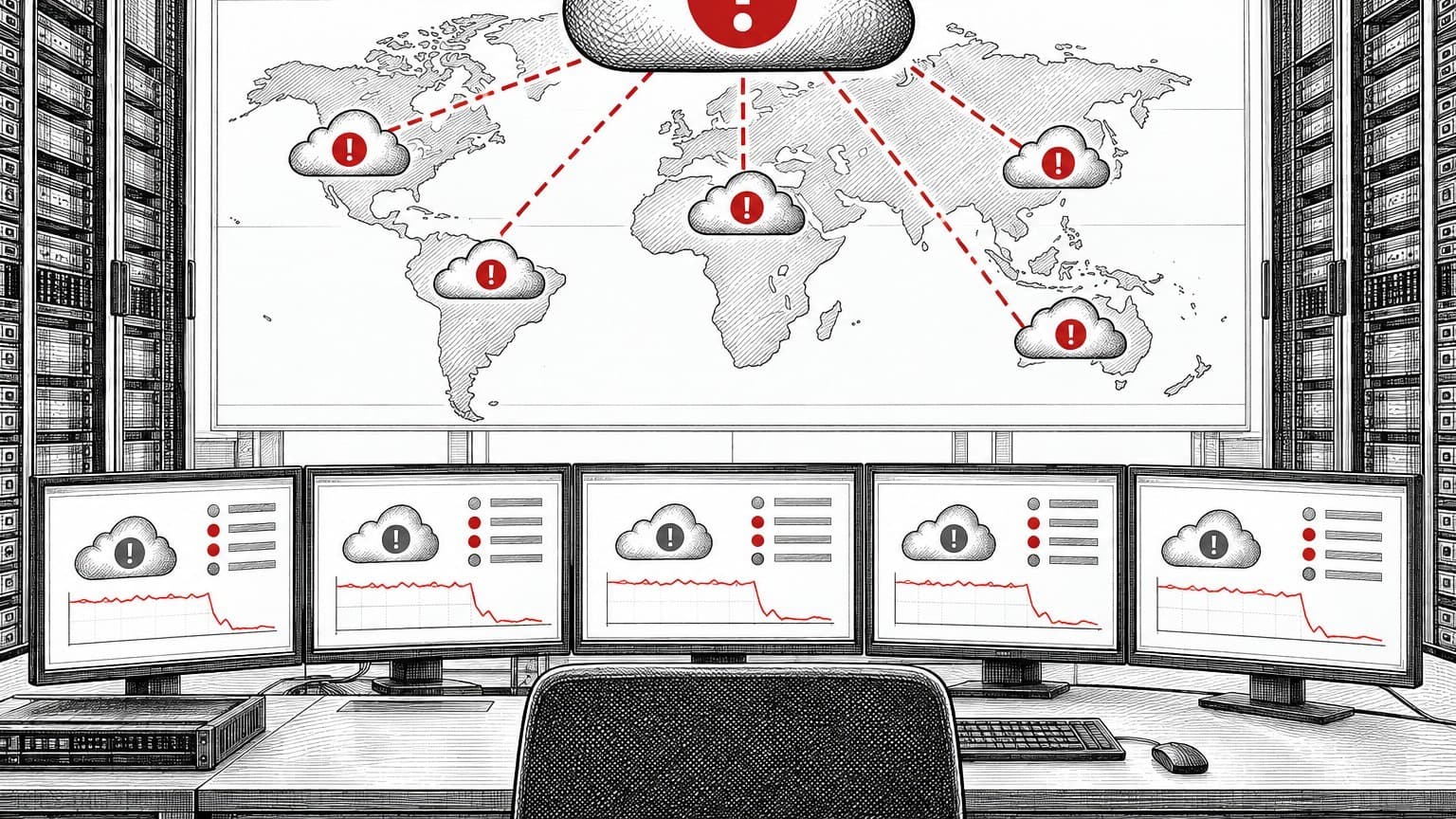
Between August 14 and September 16, a series of enterprise cloud and SaaS incidents hit systems in Australia, the US and beyond. The disruptions touched GitHub, Google Cloud, Google Drive, ChatGPT, Claude, Grok and Salesforce. The month exposed how tightly enterprises depend on third-party platforms and how unevenly providers explain failures.
On August 14, Microsoft Azure's Portal logged access issues affecting Australian regions for about 1 hour 6 minutes, and Google's security products dashboard reported a SecOps ingestion failure tied to a Proofpoint API for 2 hours 21 minutes, according to Tech Insider Australia. On August 17, GitHub's github.com, authentication, Actions, APIs, pull-request workflows and Copilot were out for 7 hours 47 minutes. SaasRise reported the incident was traced to a capacity failure in a Central US data center after monthly commits nearly doubled from 1.4 billion to 2.9 billion between April and August. The same day, Google Cloud's Melbourne region, australia-southeast2, went down for roughly 12 hours, about a month after it opened, Tech Insider Australia reported.
On August 19, Google Drive users in Australia and New Zealand began seeing HTTP 502 errors around 2:59pm AEST. Google's initial notice offered no workaround and no restoration estimate, which Tech Insider Australia called rare for a company that usually ships a status update within minutes. Google Australia confirmed to local media that "yes, there is a problem" and said engineers were working on it. Incident tracker Pagerly later put the full disruption window at 12 hours 42 minutes spanning August 18 into August 19.
On August 20, Google Cloud logged timeouts and elevated latency in us-west1 for 3 hours 40 minutes, and AWS showed a partial outage the same day per uptime tracker PulsAPI, Tech Insider Australia reported.
On September 3, OpenAI's ChatGPT, Anthropic's Claude and xAI's Grok failed simultaneously, according to MacDailyNews. Downdetector showed sharp spikes in error reports across all three within minutes. Users got failed connection warnings, severe latency or internal server errors, and developer tools such as Cursor also reported downtime. The companies acknowledged the disruptions on status pages and said they were investigating.
On September 16, Salesforce had a global outage, The Register reported. The incident began around 0830 UTC and hit instances in the US, Japan, India, the UK, France and Germany. Customers saw severe delays, intermittent errors and inability to access some services. Salesforce said an internal login service was stalling requests and consuming server resources. The vendor validated and rolled out a fix, but some instances needed manual restarts and some scheduled jobs were not running after access returned. Salesforce said the incident was resolved by 1920 UTC.
What the incidents share
Several themes emerge. First, failures cluster. Tech Insider Australia noted six incidents across all three hyperscalers inside one working week in Australia, and said shared dependencies such as identity systems, control planes, third-party API integrations and network links can produce multiple seemingly unrelated incidents. GitHub's outage showed AI features inherit the reliability limits of the underlying platform, with Copilot taking longer to recover than the core site. Second, concentration risk is high. Synergy Research Group data cited by Tech Insider Australia put AWS at 28%, Azure at 21% and Google Cloud at 14% of global cloud infrastructure spending in Q1 2026, roughly 63% combined. Third, status-page transparency varied. Google's Drive notice gave no workaround or restoration estimate, while Salesforce posted frequent updates, validated a fix on a test instance and later narrowed the impact radius. GitHub published details on root cause and scaling plans.
Planning for SaaS-heavy estates
Tech Insider Australia reported that APRA's CPS 230 requires regulated Australian banks, insurers and super funds to manage material dependencies on outsourced providers and maintain contingency and exit plans. Standard SLA credits are typically 10% of the monthly bill for affected services if uptime falls just below target and 25% for more severe shortfalls, but industry surveys put the cost of an hour of downtime at US$300,000 to US$400,000 for large enterprises. That mismatch means credits do not cover business disruption. Uptime Institute survey data cited by Cloudwards found 60% of organizations had an outage in the previous three years, down from 69% in 2021, and 14% of outages were severe or serious. Only 10% of outages in 2022 were caused by a third-party provider like SaaS or public cloud, but SaaS-heavy estates still need tested failover for critical workloads. Salesforce said its incident was resolved by 1920 UTC. The month leaves enterprise teams with a concrete checklist: treat new regions as maturing, monitor provider status pages directly, and check whether SLA credits offset downtime exposure.
Sources
- GitHub’s 7‑Hour Outage Highlights Scaling Challenges for Cloud‑Based Code Platforms, SaasRise
- 6 Cloud Outages Hit Australia in 7 Days [2026], tech-insider.org
- Major AI platforms go down in unprecedented simultaneous outage, MacDailyNews
- RunMyJobs: Pros, Cons & 19 Features, AIMultiple
- 37 Cloud Computing Statistics, Facts & Trends for 2026, Cloudwards
- Salesforce staggers back to feet after global outage, theregister
Kai Brennan covers cloud providers, outages and vendor pricing for Five Nines. He writes from status pages, vendor announcements and published reporting.
Corrections. Report an error to corrections@thefivenines.com. We list substantive corrections on the corrections page.